Prologue
What this site is — and why
"AKTE FORTUNA" is for lovers and haters of Fortuna alike. History becomes legend, legend becomes myth. And myth becomes cult — or a reason for eternal second-hand embarrassment, depending on the event.
Sometimes punk, sometimes dead silence. When "old men" suddenly become cult figures. Campino and Die Toten Hosen are Fortuna fans, the 7-1 against Bayern Munich in 1978 is the stuff of legend, and Friedhelm Funkel turned the quintessential yo-yo club into a cult institution. Fortuna Düsseldorf — the club where Rhenish joie de vivre and sporting madness shake hands.
But this site goes beyond mere celebration or hatred. Akte Fortuna is structured in three parts: The Club Dossier tells the story — triumphs, tragedies, scandals, heroes and failures across 12 chapters. Match Intelligence delivers the live data a professional needs: squad, statistics, head-to-head, injuries, form. And Predictions brings it all together — with prediction markets.
Prediction markets are not gambling. In traditional sports betting, the masses lose — the money goes to the bookmaker who has built in his margin. Betting exchanges are similar: commissions on winnings, liquidity shortages and spread eat into returns. Prediction markets work fundamentally differently. There is no bookmaker who lets the house win. Instead, money flows from those who don't know to those who get it right — with risk management, portfolio diversification and disciplined capital deployment. You can trade 24/7, build and close positions, and wait for the binary resolution of the event. Those who understand it are not speculating — they're engaged in systematic trading.
Akte Fortuna is part of Akte Bundesliga — the same concept for all 18 Bundesliga clubs. Each club gets its own dossier, its own intelligence, its own predictions. The big picture can be found at aktebundesliga.net.
Profile
Facts, figures and milestones
Profile — Facts, Figures and Milestones
Fortuna Düsseldorf, full name: Düsseldorfer Turn- und Sportverein Fortuna 1895 e. V., is a German sports club from the North Rhine-Westphalian state capital of Düsseldorf. Common short names include "Fortuna" or "Die Fortunen" — or, in reference to the club crest, "F95." Due to the club's origins in the former Düsseldorf working-class neighbourhood of Flingern, the nickname "die Flingeraner" is also occasionally used.
In the 2018/19 and 2019/20 seasons, Fortuna — after five years in the second division — belonged to the Bundesliga once again. In the all-time Bundesliga table, Fortuna Düsseldorf sits in 18th place (as of December 2019).
As of August 2019, the club has 27,000 members, making it one of Germany's 20 largest sports clubs and the fifth-largest in North Rhine-Westphalia.
Fortuna Düsseldorf's stadium is the Merkur Spiel-Arena, a multi-purpose venue built in 2004. It holds 54,600 spectators. The average attendance in the 2018/2019 season was 40,648.
Good to Know
What few people know
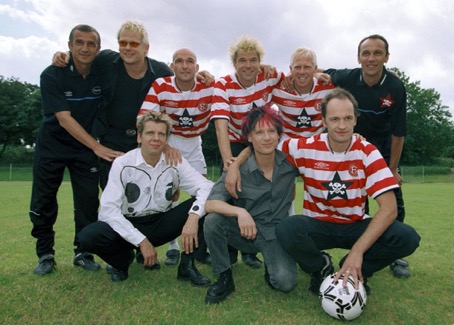
The punk band Die Toten Hosen and frontman Campino are fans of Fortuna Düsseldorf. That's practically common knowledge. Less well known is that the band helped finance "A Leg for Tony." This was well before the phase when guitarist "Kuddel" began following a strictly vegan diet in 2011.
A Leg for Tony: Anthony Baffoe's transfer from Fortuna Köln to Fortuna Düsseldorf in 1989 was co-financed by the punk band Die Toten Hosen. The band contributed part of the 100,000-euro fee — and passed the hat around during a tour under the motto "A Leg for Tony Baffoe." Baffoe, the son of a Ghanaian diplomat from Bonn, gave an interview during his time at Fortuna Düsseldorf in the 1989/90 season that made the pampered world of professional football sit up. "If I really think about it, I didn't put in a good performance today," he said, making it all the way into the ZDF Bundesliga review show. "Self-criticism, as rare as it is in..." the presenter noted. Equally cool was his quip to a referee who had just booked him: "Come on, man — us Black guys have to stick together."
Also quite unknown: The first match abandonment in Bundesliga history due to crowd trouble involved Fortuna Düsseldorf. 1. FC Kaiserslautern, November 27, 1976. It was 4:56 p.m. when an incident at the Betzenberg shook all of German football. From the Westkurve, where FCK's most loyal fans stood, small liqueur bottles rained onto the pitch during the match between 1. FC Kaiserslautern and Fortuna Düsseldorf. Referee Rudolf Frickel (Munich) alerted Kaiserslautern captain Josef Pirrung. Pirrung signalled to the stadium announcer and to FCK coach Erich Ribbeck. When more bottles flew onto the pitch, Frickel promptly abandoned the match. It was the first abandonment in Bundesliga history caused by spectator behaviour. Fortuna were leading 1-0 at the time. Weeks later, 1. FCK were held accountable for the irresponsible behaviour of a few fanatics. The consequences: a hefty fine and points deduction. Fortuna were awarded a 2-0 win at the green table — which is why, as of December 2019, only Fortuna's and Werder Bremen's records contain goals without a listed scorer.
First dog bite: Schalke's Friedel Rausch was bitten by a German shepherd in Dortmund — a one-of-a-kind incident! Wrong — a football legend that is simply false. Fortuna Düsseldorf's left winger Dieter Wöske was the first bite victim in a top-flight match on German soil a full ten years earlier, on April 6, 1959. During a home Oberliga West match against 1. FC Köln, Wöske fled from euphoric spectators into the goal and was bitten through the net by a police dog named Ajax. One way to leave your mark…
For the Haters
Embarrassing disasters and major defeats
In German football, Fortuna Düsseldorf has the unflattering reputation of being a "yo-yo club."
Oberliga Nordrhein: Fortuna Düsseldorf's greatest footballing embarrassment came outside the top two divisions. 17th place in the third-tier Regionalliga Nord in 2001/02 meant relegation to the Oberliga Nordrhein.
Four coaches: 20th place, just six wins (a club negative record) and four coaches burned through (Josef Hickersberger, Rolf Schafstall, Horst Köppel, Jürgen Gede) made the mammoth 1991/92 Bundesliga season with 20 teams the absolute low point. From 1999, a full decade of amateur football followed…
Heaviest Bundesliga defeat: Fortuna Düsseldorf's heaviest Bundesliga defeat to date remains the 0-7 (0-2) against VfB Stuttgart in the 1985/86 season. Stuttgart swept through the Düsseldorf Rheinstadion like a tornado on March 15, 1986, with goals from Michael Spies and Karl Allgöwer plus five (!) from Jürgen Klinsmann…
Heaviest away defeat: Fortuna Düsseldorf lost 7-0 at FC Bayern Munich on matchday 21 of the 1981/82 season.
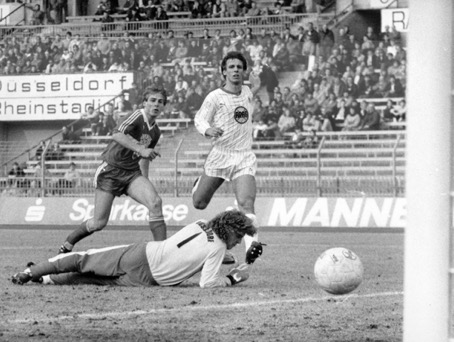
Longest losing streak: F95 lost 10 consecutive matches from matchday 31 to 34 of the 1990/91 season and through to matchday 6 of the following season.
The low point: 0-6 in the Oberliga against Wuppertal! In a clash of two former Bundesliga clubs, Fortuna Düsseldorf were demolished 0-6 (0-2) on November 30, 2002 in the fourth-tier Oberliga Nordrhein at the Stadion am Zoo in Wuppertal. Good thing only 5,000 spectators witnessed it…
The most embarrassing turnaround in a Bundesliga match against Fortuna: Matchday 31 of the 1990/91 season: While all of German football was transfixed by the title showdown between Kaiserslautern and Bayern Munich, a highly dramatic match was also unfolding at the Düsseldorf Rheinstadion. A 3-0 lead against VfL Bochum through goals from Jörn Andersen, Martin Spanring and Thomas Allofs wasn't enough for a win — not even for a single point. Michael Rzehaczek, Josef "Jupp" Nehl, Dirk Helmig and Frank "Funny" Heinemann turned the match between the 36th and 69th minutes. Older fans had déjà vu: the same thing had happened to Fortuna in 1980, when they squandered a 3-0 lead at 1860 Munich.
Drama against HSV: Düsseldorf, August 3, 2009. In the first round of the DFB-Pokal against Hamburger SV, Fortuna suffered one of their bitterest defeats ever. It was 3-3 after 120 minutes. Andreas "Lumpi" Lambertz had equalised the Hamburg 3-2 lead — set up by two goals from international Piotr Trochowski — in stoppage time of extra time, sending the Düsseldorf Arena into raptures. But in the penalty shootout, the Hamburgers were cool as ice. They converted four penalties, while on Fortuna's side Oliver Caillas and Sebastian Heidinger both failed against HSV goalkeeping legend Frank "Fäustel" Rost.
For the Lovers
Key triumphs and major victories
Fortuna Düsseldorf's greatest achievements to date remain the German championship in 1933, reaching the final of the European Cup Winners' Cup in 1979, and back-to-back DFB-Pokal triumphs in 1979 and 1980.
Cup Winners' Cup final: In 1979, the team coached by Hans-Dieter Tippenhauer — featuring Klaus and Thomas Allofs, Dieter Brei, Rudi Bommer, Egon Köhnen and Gerd Zewe among others — reached the final of the European Cup Winners' Cup, having qualified as cup runners-up. They had lost the 1978 DFB-Pokal final to champions 1. FC Köln. In a dramatic final in Basel, Fortuna fell to FC Barcelona 4-3 (2-2, 2-2) after extra time. Sanchez struck in the fifth minute for the Spaniards. Three minutes later, the Allofs brothers equalised — who touched the ball last remains disputed to this day, though it is officially credited to Thomas. In the 12th minute, goalkeeper Jörg Daniel saved a Spanish penalty. Asensi restored Barcelona's lead, and Wolfgang Seel equalised again before half-time. Fortuna dominated the second half but couldn't score. In extra time, Rexach put the Catalans ahead. Düsseldorf pushed for another equaliser but conceded the decisive 4-2 through Hans Krankl. Wolfgang Seel pulled one back — 3-4. That was all they had.
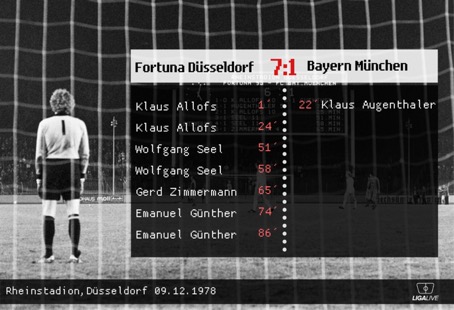
The 7-1 against Bayern: With their best-ever finishes of third in 1972/73 and 1973/74, Düsseldorf only saw the Bundesliga championship trophy from afar. But on December 9, 1978, the Rheinstadion — known as "die Schüssel" (the bowl) — witnessed a match worthy of champions. Fortuna Düsseldorf demolished the mighty Bayern Munich 7-1 — Bayern's heaviest away defeat in Bundesliga history. Two goals each from Klaus Allofs, Wolfgang Seel and Emanuel Günther, plus one from Gerd Zimmermann, made for a match whose scoreboard photo is still used on Fortuna fan t-shirts to this day…
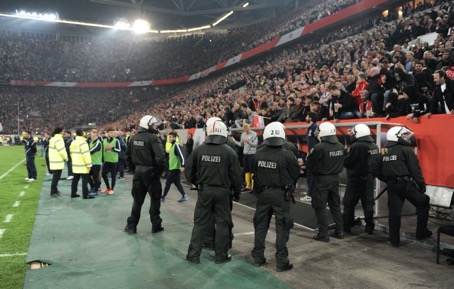
In the end, they made it: Fortuna Düsseldorf humiliated Hertha BSC in the relegation playoff. The Bundesliga witnessed turbulent relegation drama at its finest in May 2012. As third-placed finishers, Düsseldorf had stormed the Berlin Olympiastadion with a 2-1 win, inflicting a painful defeat on the (still-)Bundesliga side Hertha BSC. The Berliners couldn't reverse the result on May 15, 2012 in the cauldron of the Düsseldorf Arena — 2-2. A pitch invasion by Fortuna fans nearly derailed everything. The Berliners protested after the match interruption and got tangled up in dubious legal claims. The DFB rejected Hertha's request for a rematch, and Düsseldorf went up — despite the chaotic scenes near the end.
Back-to-back DFB-Pokal winners: In 1979 and 1980, Fortuna Düsseldorf achieved what their Rhineland rivals 1. FC Köln had last done in 1977 and 1978 — they defended the DFB-Pokal! The 1-0 victory in Hanover in the 1979 final against Hertha BSC, decided by a Wolfgang Seel goal after extra time, was followed in 1980 by perhaps the most prestigious triumph of all. At the Parkstadion in Gelsenkirchen — until 1985, the final was held at a different venue each year — F95 beat 1. FC Köln 2-1. Rüdiger Wenzel (59') and Thomas Allofs (65') overturned Köln's 1-0 half-time lead, scored by World Cup winner Bernd Cullmann (26'), within six minutes, triggering incredible scenes of celebration! Fortuna coach Otto Rehhagel played the trumpet in celebration. It wasn't until January 1981 that Fortuna lost another cup match, and the club can still boast a record run of 18 consecutive DFB-Pokal victories (as of December 2019).
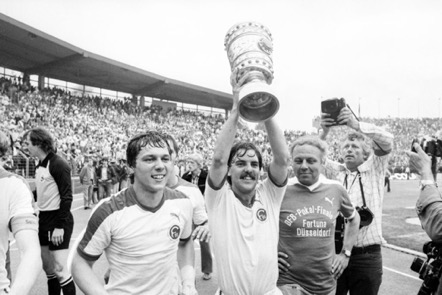
Biggest Bundesliga win: Unsurprisingly, the biggest Bundesliga win came under the reign of "King" Aleksandar Ristic. On matchday 34 of the 1989/90 season, Fortuna demolished FC St. Pauli 7-0 at the Rheinstadion. The same scoreline had already been achieved in 1983/84 under Willibert Kremer against Borussia Dortmund — unfortunately without the crowds. Only 11,000 attended the BVB match and 13,500 the St. Pauli rout, the highest victories for the Rhinelanders in the top flight as of December 2019.
Biggest away win: F95 recorded their biggest away wins in the 1st and 2nd Bundesliga on three separate occasions. On matchday 6 of the 1978/79 season, they beat SV Darmstadt 6-1 in Darmstadt. They won 7-2 at Blau Weiss Berlin on the 38th matchday of the 1988/89 season. And they triumphed 5-0 at Karlsruher SC on matchday 24 of the 2011/12 season.
Most wins: Fortuna Düsseldorf achieved 20 wins in the 1987/88 second-division season.
Longest winning streak: F95 won six consecutive matches from matchday 33 to 38 of the 1988/89 second-division season.
Most Important Persons
The men who shaped the club
The record-breaking brothers: They are the pair of siblings with the most Bundesliga appearances. Between them, the Allofs brothers played 802 top-flight matches — European Champion and World Cup runner-up Klaus notching 424, his younger brother Thomas 378. That puts the Düsseldorfers well clear of…
The record holder: Born in the Saarland, Zewe arrived in 1972 from former Bundesliga club Borussia Neunkirchen and went on to make 440 Bundesliga appearances for Fortuna Düsseldorf by the time he departed in 1987 — most of them as sweeper. A record that will stand for a very long time.
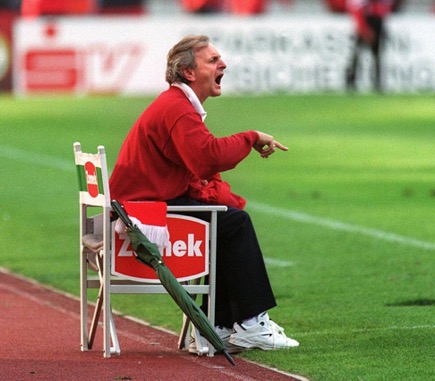
"King Aleks": No other coach enjoys such cult status in Düsseldorf as "Aleks" Ristic. His press conferences and his quips — "I would like to drink a tea" / "They can say what they want" — are as unforgettable as the cough drops he slipped to assistant referees…
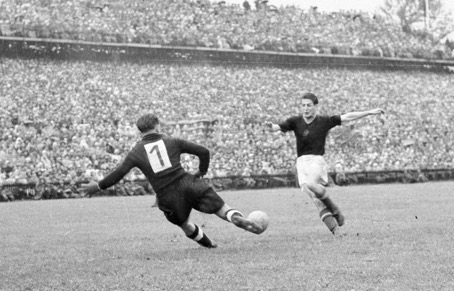
"Football God" and World Cup winner: The goalkeeper of Germany's "miracle" team of Bern 1954 kept goal in 133 Oberliga matches for Fortuna between 1950 and 1956. His save against Hungary's superstar Ferenc Puskás in the World Cup final against the Magyars (3-2) lives on through Herbert Zimmermann's legendary radio commentary…
The "Great Silent One": The defender and 1933 championship winner from Fortuna Düsseldorf was never a man of many words. He once described good timing in aerial duels like this: "You have to jump higher than your opponent at the right moment." That settles that. His great speciality…
Personae Non Gratae
The men fans love to hate
Goalscorer in the storm of outrage: The Düsseldorf-born striker, who scored 20 goals in 88 league appearances for Fortuna between 1986 and 1990, tried in 2012 to use every legal means available to prevent the promotion of his former club via the relegation playoff. Even though the DFB rejected Hertha's request for a rematch on May 21, 2012, the Berliners got tangled up in dubious legal claims…
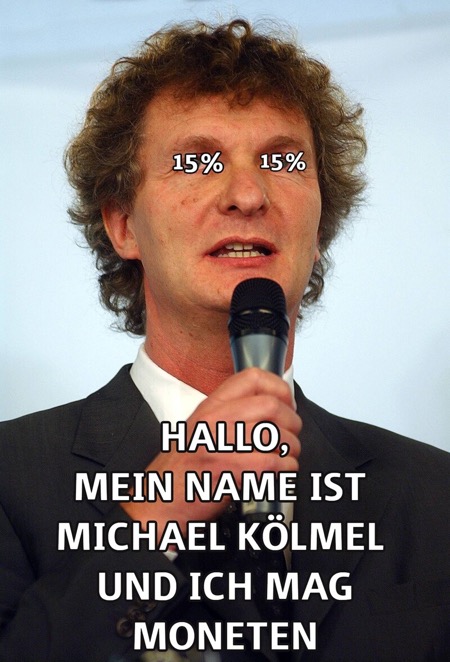
Because they're still paying: And they're still paying… Fortuna Düsseldorf continues to suffer from the financial misery of the 1990s and early 2000s to this day. Even after their 2018 Bundesliga promotion, the club still had to pay a hefty share of their TV revenue to Michael Kölmel ("Kinowelt"). A full 15 percent…
The biggest transfer flop: It seems bizarre that Macedonian striker Darko Pancev — a European Cup and Intercontinental Cup winner with Red Star Belgrade in 1991 — after an already failed stint at relegated VfB Leipzig (1993/94), turned up at Fortuna Düsseldorf in 1995/96…
Tragic
Those who suffered misfortune
Toni Turek — "I haven't had much luck in life": That's what Toni Turek said at some point towards the end of his life. Understandable, when you look at his post-career years. Until 1973, Turek worked largely out of the public eye in the administration of the Düsseldorf Rheinbahn — then fate struck one Sunday morning in September 1973. Toni Turek couldn't get out of bed: paraplegia, probably caused by a virus. The cause was never determined. Years of suffering followed. Countless operations that made nothing better. In 1977, Turek took early retirement, confined to a wheelchair or crutches. On May 11, 1984, the Hero of Bern died from the consequences of a stroke. He was buried at the Lindenheide cemetery in Mettmann.
Atli Edvaldsson — The Icelander: Born in Reykjavik in 1957, the 6'5" giant arrived in Germany in 1980, initially to score goals for Borussia Dortmund. He netted 11 in 30 appearances. Fortuna brought the striker to the Rhine, where he scored 112 goals in 219 matches. He once finished second (21 goals) in the top-scorer chart behind Rudi Völler (23 goals). On June 5, 1983, Edvaldsson scored five in a 5-1 win against Eintracht Frankfurt. He continued playing until 1994. From 1999 to 2003, he served as Iceland's national coach, then retired from football. He passed away in the autumn of 2019 after a long illness, aged 62.
OMG — Oh My God
You can't be serious
Sometimes punk, sometimes dead silence: Fortuna Düsseldorf between emotional extremes. The only constant at Fortuna Düsseldorf, or so uber-fan Campino believes — real name Andreas Frege (a name with which a world career was hardly going to happen…), singer of the punk band Die Toten Hosen — is that "the sausages probably taste the same even in the Regionalliga." That's hard to verify. What is certain is that Die Toten Hosen provided the club with financial lifelines during its darkest days. Punx not dead!
Shirt sponsor from 2001 to 2003: Few band names could better capture the financial and sporting chaos surrounding Fortuna Düsseldorf than Die Toten Hosen ("Dead Trousers"). With Bundesliga relegation in 1992, Fortuna's finances went into a tailspin. A 21st-place finish in the 2. Bundesliga (then 24 teams) in 1992/93 meant the plunge into the Oberliga! There was a dance of death in the World Cup and European Championship stadium of 1974 and 1988. In the 1992/93 second-division season, an average of just 5,726 fans rattled around the Rheinstadion. By 2000/01, the Flingeraner appeared on the brink of total financial collapse in the Regionalliga Nord. The celebrity fans from Die Toten Hosen stepped in. Having already co-financed fan favourite Anthony Baffoe's transfer in 1988, they now rescued their Fortuna as shirt sponsors from 2001 to 2003.
Fortuna Düsseldorf and the Rheinstadion — All for Love? When Fortuna's Bundesliga home ground was demolished in two waves in November 2002, a touch of melancholy surfaced at the very last moment. Former stadium announcer Dieter Bierbaum, wearing a hard hat with the Fortuna logo, watched from a safe distance as the 1974 World Cup arena was reduced to rubble in seconds. "It's an insane feeling to see this," Bierbaum said at the time, his voice trembling. "This stadium wrote sporting history — 22 years of Bundesliga with Fortuna Düsseldorf, all gone, just like that." Only the Nordkurve terrace remained standing temporarily, as water pipes running beneath it were essential for the new arena. The ball rolled at the Rheinstadion for the last time on March 3, 2002. In the 1-1 draw against arch-rivals Rot-Weiß Essen, Fortuna's Nigerian player Ganiyu Shittu scored the last-ever goal in the stadium's history. Remarkably, two European cup finals were held at the Rheinstadion in 1979 and 1981. Borussia Mönchengladbach won the UEFA Cup there, and Dynamo Tbilisi beat FC Carl Zeiss Jena — coached by the legendary Hans Meyer — to win the Cup Winners' Cup in 1981. The 4,750 spectators in the enormous concrete bowl for the Jena match remain a record low attendance for a European final to this day.
Toni Turek — a Football God? Not according to Sepp Herberger. "While Toni's play on the goal line deserves the highest praise and recognition, the same cannot be said of his cooperation with the players in front of him. Toni never had his defence under control the way one had to expect of him." Sepp Herberger didn't have only kind words for Toni Turek. Not just Turek's phlegmatic nature irked Herberger, but also his occasional showboating — like catching balls with one hand. "The desire for spectacle was in his blood. He barely took notice of the cautionary criticism from those around him, or simply let it go in one ear and out the other."
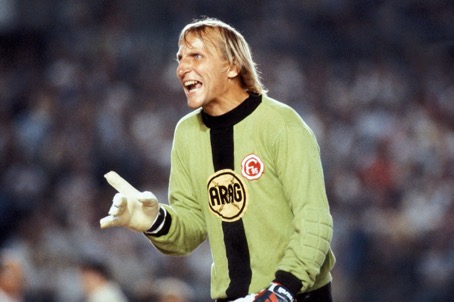
Scandal in front of the main stand: "Say goodbye softly with a Servus," goes the classic by Erwin Bolt and his dance band. But that wasn't enough for Wolfgang Kleff. After the end of his time at Gladbach and a brief stint at Hertha BSC, "Otto" Kleff joined Fortuna Düsseldorf in 1982. The 35-year-old veteran goalkeeper quickly became a crowd favourite. Despite solid performances, his contract was not renewed in May 1984. On matchday 33, Kleff was allowed to start in F95's last home match of the season. In the 73rd minute, he'd had enough. He faked an injury and had himself substituted. Kleff, fit as a fiddle, set off on a lap of honour. The fans paid tribute to "Otto" and received in return: "I gave the fans what they wanted: gloves, shirt, boots, the lot," he recalled later. Then came the scandal in front of the main stand. Kleff turned around, bent over and dropped his shorts. He appeared to be mooning the main stand — and above all Fortuna president Bruno Recht, who had refused to extend his contract. "For the fans, I'll give my last shirt — for certain others, only my backside," Kleff explained after the match.
Fun Facts
Knowledge for blowhards, braggadocios and connoisseurs
Everyone in Cologne, Mönchengladbach and Leverkusen knows that Fortuna Düsseldorf have never been Bundesliga champions. But here are fun facts about "Tuna" that not everyone knows…
The Emperor of the Rhine: Light-footed, with superb vision and tactical intelligence — in short, just like Franz Beckenbauer — that's how Gerd Zewe played in the Fortuna Düsseldorf shirt. But the club's record appearance-maker never quite stepped out of the Munich original's shadow and earned only four caps. After Beckenbauer's departure from the national team, Zewe was allowed to travel to the 1978 World Cup in Argentina, but was given nothing more than a free seat on the bench or in the stands whenever the defending champions played. Manager Schön preferred Berti Vogts, Manfred Kaltz, Rolf Rüssmann and Bernhard Dietz in defence — including in the decisive match against Austria, which ended in the "Disgrace of Córdoba."
The Karlo Party: One Fortuna Düsseldorf player enjoys absolute cult status. Karl "Karlo" Werner, who made 145 Bundesliga appearances for Düsseldorf. At the local university, a party was named after him: the DKP — Düsseldorfer Karlo-Partei. Whether it ever cleared the 5% threshold at F95 is unknown… and what the humourless communists and GDR sympathisers of the actual DKP (Deutsche Kommunistische Partei) in the old West Germany thought of the Karlo Party is likewise not recorded.
Never longer than three: Since their second relegation in 1987, Fortuna have never managed more than three consecutive seasons in the Bundesliga. From 2002 to 2004, they even had to play in the then fourth-tier Oberliga. In 2008, the club qualified for the newly founded 3. Liga. In 2009, they returned to the 2. Bundesliga. In 2012, the team secured promotion via the relegation playoff. The following season, they were relegated again under dramatic circumstances.
10th place and the "old man": A 10th-place finish in 2018/19 for the team coached by Rhinelander Friedhelm Funkel was a notable achievement. "Fortuna were one of the biggest surprises," said former F95 pro Mike Rietpietsch. "That was only possible because the club finally found some stability." Things weren't quite that calm, though: during the winter break, CEO Robert Schäfer announced the decision to part ways with Funkel at the end of the season, citing a disagreement over contract length. The supervisory board reversed Schäfer's decision after massive fan protests, and by the season's end it was Schäfer who had to go — while Funkel survived until the second half of 2019/20, when he was replaced by Uwe Rösler.
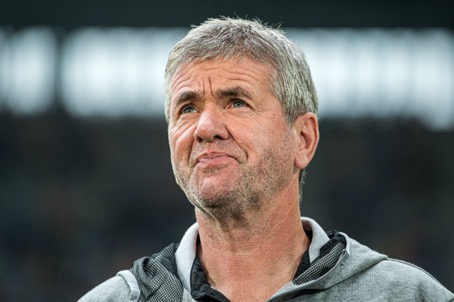
Friedhelm, the record promoter: Coaching legend Friedhelm Funkel didn't arrive at Fortuna Düsseldorf until 2016. In 2018, the Neuss-born manager set a new record in the club's service. The Bundesliga promotion (as 2. Bundesliga champions) was his sixth career promotion — an absolute record. Previously, Funkel had guided Bayer Uerdingen (twice), MSV Duisburg, 1. FC Köln and Eintracht Frankfurt to the Bundesliga. On October 5, 2019, Funkel took charge of his 500th Bundesliga match as a manager — a 1-3 defeat at Hertha BSC. On January 29, 2020, F95 announced the separation from Funkel. He subsequently declared his coaching career over.
"Lumpi" Lambertz — been through the lot: Former Fortuna youth player Andreas "Lumpi" Lambertz achieved his dream in 2012 and set a unique record in German professional football. He was promoted to the Bundesliga with Düsseldorf, having previously marched all the way up from the fourth tier with the club.
The World Cup-winning attack: In the first match after winning the 1974 World Cup, Germany took to the field in Basel on September 4. Manager Helmut Schön experimented, giving left winger Dieter Herzog — who had already featured at the World Cup — a start alongside Reiner Geye on the right. At half-time, he also brought on centre-forward Wolfgang Seel, meaning Fortuna Düsseldorf provided the entire forward line of the reigning World Champions for 45 minutes. A proud and unique day in the club's history, crowned by Geye's winning goal in the 2-1 victory.
A red rag for public television: Fortuna were one of the first Bundesliga clubs to adopt a shirt sponsor in 1974. Eintracht Braunschweig had broken the taboo in 1973 with "Jägermeister," and the DFB grudgingly approved. But the public broadcasters were less forgiving. On their bright red shirts, Fortuna advertised the supermarket chain "allkauf" (fee: 50,000 DM per year) and thus became a red rag for ARD and ZDF, who threatened not to broadcast matches featuring sponsored clubs — citing stealth advertising. Allkauf didn't want to be blamed and terminated the contract at short notice, so by 1975/76 Fortuna had a plain shirt again. But not for long: as times changed, so did attitudes towards commercialisation in professional sport, and from 1976 Fortuna advertised the insurer Arag. The shirt with its yellow circle on the chest became a cult item among fans.
Special Moments
"I simply happened to be in the right place at the right time…"
"I simply happened to be in the right place at the right time… Really, anyone else could have scored that goal!" Jürgen Schult laughs and shrugs his shoulders. The memories of the most important goal of his life no longer seem to stir the 80-year-old.
Back then, in August '66, he was the one who scored against reigning European Cup holders Borussia Dortmund. As if that weren't special enough, it was simultaneously the very first Bundesliga goal in Düsseldorf's history. "It was my birthday. It was our first Bundesliga match as a promoted side. It was simply my day!" Inside forward Schult, who had played for DSC 99 in his youth, returned to Düsseldorf in 1964 after two failed promotion attempts with Viktoria Köln.
"I was studying at the German Sport University and training under Hennes Weisweiler. I was turning more and more into a Cologne man and was relieved when the offer came from my hometown," Schult recalls with a wink. Cologne made him good; Düsseldorf made him immortal.
The road to the Bundesliga had been anything but smooth for the Rot-Weißen. Fortuna, regular participants in the top tier of the Western German Football Association since the 1920s, first reached the German championship playoff round in 1927. A defeat to Hamburger SV denied them the title at the very last moment.
"I wasn't even born when Düsseldorf celebrated their first great success," Schult recalls, referring to June 11, 1933. Düsseldorf defeated Schalke 3-0 and brought the German championship to the Lower Rhine. Historic and unique to this day. After the introduction of the Bundesliga in 1963, promotion initially eluded Düsseldorf. Despite strong performances, two third-place finishes in the first two seasons weren't quite enough for the top flight. But the Rhinelanders were already among the leading teams in the Regionalliga West early on — something that didn't escape Jürgen Schult's notice, 50 kilometres further south:
"Even though I was under contract in Cologne at the time, I never lost sight of what was happening in Düsseldorf," the senior recalls. His feet in Cologne, his heart in Düsseldorf — Schult observed his hometown's achievements longingly from afar. "Düsseldorf was my dream club," he would say many times over the coming years. He had no idea that Fortuna also had their eye on him.
When Schult pulled on the F95 shirt for the first time in the summer of 1965, it immediately felt like home. "In Düsseldorf, I found everything I had been looking for" — and more. Since good things come in threes, in December 1965, in the third season after the Bundesliga's founding, Fortuna won the autumn championship and ushered in one of the most successful seasons in their history with their new striker.
Finishing comfortably at the top with just two defeats all season, Düsseldorf were drawn into promotion playoff Group 1 alongside Hertha BSC, FK Pirmasens and Kickers Offenbach. "I still remember the 2-0 home win against Pirmasens on the penultimate matchday, which drew us level on points," says Schult with a grin. The memories of June 26, 1966 still bring him joy to this day. "There were 15,000 Fortuna fans at the Bieberer Berg when we walked out in Offenbach for the final matchday. The stadium only held 20,000." Laughter and a shake of the head at the Düsseldorf dominance that day.
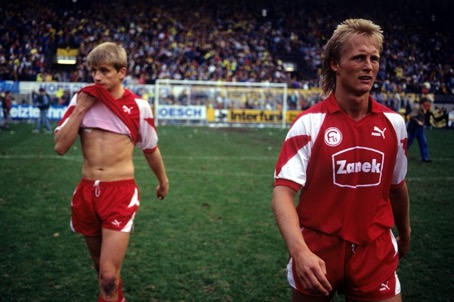
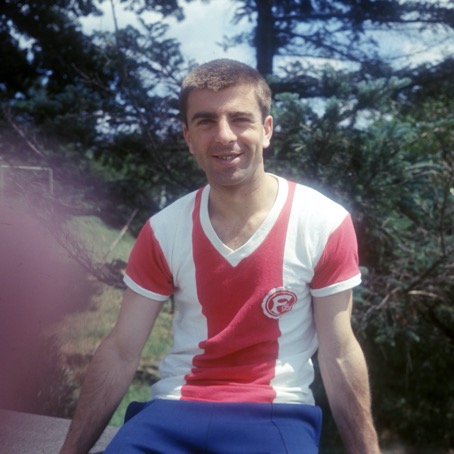
"We basically couldn't lose," Schult sums up with amusement. Although Pirmasens beat Hertha 2-1 on that final matchday, Düsseldorf pulled off the sensation in Hesse. With the Bieberer Berg firmly in Fortuna's hands, the visitors led 3-0 at half-time. "Peter Meyer and Waldi Gerhardt put us clearly ahead right at the start, before I got my turn in the second half." Jürgen Schult and Werner Biskup extended the lead amid goosebumps and thunderous chanting to 5-0. A consolation goal for Offenbach followed, and at the final whistle the ground erupted.
"15,000 Fortuna fans stormed the pitch. I couldn't believe what was happening." Schult looks down, and for a moment the emotions seem to overwhelm him. "Unfortunately, our emphatic victory also attracted critics." Rumours surfaced that the win in Offenbach had been bought for 35,000 marks. Evidence? None. Gossip? Plenty. "The club silenced the accusations with an injunction, but the allegation never truly went away." Schult knew nothing of any bribery. He simply played good football that day.
The fan favourite had long since become indispensable for Düsseldorf, but it was August 20, 1966 that turned the birthday boy into a legend. "We played in a sold-out Rote Erde stadium in Dortmund," Jürgen Schult begins his favourite story, gazing wistfully into the distance. It's as though he's reliving the moment. "The fact that our first Bundesliga match fell on my 27th birthday was the finest gift I could have wished for."
On that Saturday in August, newly promoted Düsseldorf faced European Cup holders Borussia Dortmund in their maiden Bundesliga match. After a goalless first half, the ball found its way to striker Jürgen Schult in the 65th minute. "I didn't think, I just did my job" — and he did it well. "The opposing goalkeeper Bernhard Wessel also had his birthday that day, but not as happy a one as mine." The mischievous grin can't hide the pride in Schult's voice.
Wise Words
Quotes for eternity
"In life, you always need something to believe in — even if it's just Fortuna Düsseldorf."
Campino, F95 fan and singer of the veteran punk band Die Toten Hosen"Tünn, we've got a right posh bloke among us — he keeps saying 'Mr Janes.'"
Paul Janes to coach Toni Rudolph in 1933, about Matthes Mauritz, who had addressed him formally"You can come work on my plantation."
Anthony Baffoe to a heckling opponent"Last night we already had a draw — 67-67 in a beer-drinking contest against Reiner Calmund."
Werner Fassbender, former F95 manager, after the 3-3 at Leverkusen in 1989"Get the antidepressants out — Fortuna Düsseldorf are playing."
WDR reporter Manni Breuckmann